Partnerships
Dubai Chambers signs two new agreements to deepen ties with China's Greater Bay Area
Dubai Chambers signed two memorandums of understanding with Chinese business associations in Shenzhen, opening fresh channels between Dubai's private sector and companies across the Greater Bay Area. The agreements are narrow on paper but point to a wider strategy.
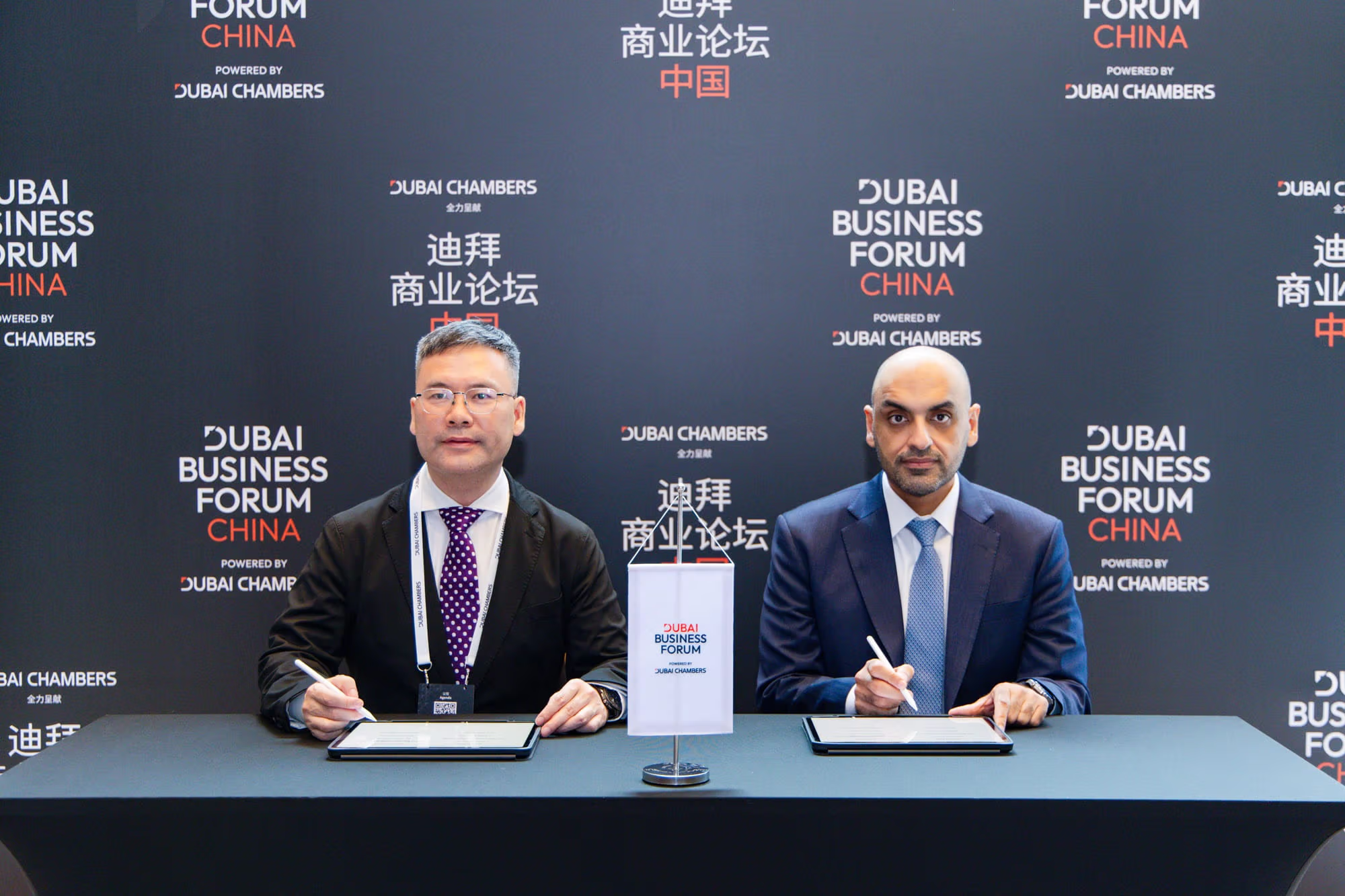
Dubai Chambers signed two memorandums of understanding with Chinese business associations on the sidelines of the Dubai Business Forum – China, held in Shenzhen on 20 October. Both agreements target the same region, the Greater Bay Area, which links Hong Kong, Macau and nine mainland Chinese cities into one of the world's densest manufacturing and technology clusters, and both are aimed at giving Dubai-based companies a more direct route into it.
The first was signed with the Greater Bay Area International Economic and Trade Association, with H.E. Mohammad Ali Rashed Lootah, President and CEO of Dubai Chambers, putting his name to it alongside the association's Executive Chairman, Mr. Zhao Huazhong. The second was signed with the GBA Entrepreneurs Alliance, represented by Salem AlShamsi, Dubai Chambers' Executive Vice President of International Relations, and Ms. Diana Dai, Executive President of the Alliance's UAE Chapter.
What the agreements actually do
Neither MoU commits either side to capital or to a specific project. What they set up instead is a framework: structured knowledge exchange, more direct lines of communication between companies on each side, and a formal channel for exploring new commercial partnerships as they come up. That is a modest scope by design. Agreements like these function less as deals in themselves and more as the plumbing that makes future deals easier to close, by giving businesses on each side a known point of contact instead of starting from nothing.
- Dubai Chambers signed two MoUs with Chinese business associations in Shenzhen on 20 October.
- The first was signed with the Greater Bay Area International Economic and Trade Association.
- The second was signed with the GBA Entrepreneurs Alliance's UAE Chapter.
- Both agreements establish frameworks for knowledge exchange and direct company-to-company communication.
- The signings took place at the Dubai Business Forum – China.
- China was Dubai's largest single trading partner in 2025, accounting for close to a third of the emirate's free zone trade.
“We are committed to expanding our network of international partnerships, connecting Dubai's business community with promising opportunities around the world.”
Why the Greater Bay Area specifically
The choice of partner is not incidental. The Greater Bay Area is one of the most concentrated manufacturing and technology corridors anywhere, and it already sits close to the top of Dubai's trading relationships. China was Dubai's single largest trading partner last year, representing close to a third of the trade flowing through the emirate's free zones, ahead of Saudi Arabia and India. An agreement that gives Dubai companies a more direct line into the cities that produce a large share of that trade is less a new direction than a reinforcement of the relationship that is already doing the most work.
Our reading
Two things make this worth watching beyond the signing photos. First, the structure of the agreements, aimed at company-to-company contact rather than government-to-government commitments, is the model Dubai Chambers has leaned on elsewhere to grow trade relationships organically, letting individual businesses find the deals rather than mandating them from the top. Second, doing this with the Greater Bay Area specifically, rather than with China more broadly, suggests Dubai is trying to deepen its existing strongest trade relationship rather than simply diversify away from it. The test for an MoU like this is never the signing itself but what follows over the next year or two, whether Dubai-based firms actually use the new channel to close deals in Shenzhen, Guangzhou and Hong Kong, or whether it ends up as one more agreement in a long list of partnerships that never quite translate into trade volume.
Topics